


Micromobility Risks: Pedestrian Injuries from Bicycles and Electric Scooters:
A Comparative Analysis in Downtown Houston, EaDo, and the Texas Medical Center
Prepared by: Texas Urban Planning Agency (TexasUP)
Author: Aviboaz Arroyo / Research Assistant: Mikell Kirbis
© 2025, All Rights Reserved, Texas Urban Planning Agency. All persons and entities are permitted to use this document and its contents free of charge, provided such use complies with the additional terms and conditions set forth below, which are a condition of authorized, non-exclusive use.
Date: September 2025
About the author: Aviboaz is both a structural engineer, a certified urban planner and went to college at the Engineering College of Israel and has worked on several infrastructure and urban planning projects in the United States, Israel, Japan and Spain.
Executive Summary
The rapid growth of micromobility in Houston, particularly electric scooters (e-scooters), has prompted public concern regarding pedestrian safety. Many Houstonians perceive scooters as uniquely hazardous compared to bicycles. However, engineering analysis and available data indicate that the risks posed to pedestrians by bicycles and e-scooters are functionally similar to that of bicycles.
This report compares pedestrian injuries caused by bicycles and e-scooters in three critical Houston districts—Downtown, East Downtown (EaDo), and the Texas Medical Center (TMC). It evaluates:
- Total pedestrian injuries linked to bicycles vs. scooters.
- Relative severity of injuries.
- Kinetic energy analysis, showing that a typical e-scooter at 15 mph carries energy comparable to a bicycle at the same speed.
- Speed overlap, where experienced cyclists often travel at or above common e-scooter speeds.
- Public perception vs. reality, highlighting that scooter fears do not align with injury statistics.
- Broader benefits of e-scooters, including reduced fuel use, lower parking demand, and decreased infrastructure costs.
Findings suggest that while pedestrian collisions remain rare relative to car–pedestrian crashes, bicycles are at least as responsible for pedestrian injuries as scooters in Houston’s urban districts. Injury severity is comparable across both modes, driven primarily by speed and impact mechanics rather than vehicle type. Additionally, the role of micro-mobility in Texas and more specifically Houston is often overlooked and undervalued. This includes bicyclist and electric scooter riders. Without providing for these important forms of transit, the Houston urban areas will only suffer greater traffic congestion, traffic related injuries and more cost and frustration associated with roads, and automobiles.
Overall, we find that on a per capita basis, electric scooters and bicycles present the same amount of risk to pedestrians, which is relatively low compared to automobiles, and that both are essential components to the transportation infrastructure and quality of life and that the city should work to improve integration into the urban areas of Houston, which will result in a lower all-transportation injury rate.
1. Introduction
Houston’s urban districts are experiencing increasing modal diversity. Since 2012, Houston BCycle has expanded to over 150 stations, generating tens of thousands of trips annually. In 2018, dockless e-scooters arrived, adding a new mobility layer. While these devices increase accessibility and reduce car dependency, they also introduce safety concerns, particularly for pedestrians in dense areas.
The Texas Urban Planning Agency (TexasUP) researched and wrote this report to provide an engineering-based comparative analysis of pedestrian injury risks between bicycles and e-scooters, focused on Downtown Houston, EaDo, and the Texas Medical Center. These districts were selected because they represent the city’s highest concentrations of pedestrian activity and micromobility use.
2. Methodology
The report synthesizes multiple sources of information, including local crash reports from the City of Houston, Houston Public Works, and the Houston Police Department, Medical Reports, Insurance claims, as well as peer-reviewed research on bicycle and e-scooter injuries. National datasets, such as those maintained by the Consumer Product Safety Commission and the National Electronic Injury Surveillance System, were consulted where local pedestrian–micromobility collision data proved incomplete. Finally, engineering principles, including kinetic energy calculations and speed analysis, were applied to demonstrate the functional similarities between bicycles and e-scooters in pedestrian collisions.
This report synthesizes:
- Local crash reports from the City of Houston, Houston Public Works, and Houston Police Department (where available).
- Peer-reviewed research on bicycle and e-scooter injuries.
- National datasets (e.g., Consumer Product Safety Commission [CPSC], National Electronic Injury Surveillance System [NEISS]).
- Engineering analysis, including kinetic energy calculations and comparative speed studies.
Where local pedestrian–micromobility collision data is incomplete, regional and national findings are used to establish engineering equivalency.
3. Pedestrian Injury Trends
At the national level, the Centers for Disease Control and Prevention estimates that there are approximately 45,000 pedal-cyclist injuries annually in the United States. Roughly 5% – 10% of these involve pedestrians rather than motor vehicles. Electric scooters, according to the Consumer Product Safety Commission, accounted for approximately 50,000 emergency room visits in 2022, with around 11% of these cases involving pedestrians struck by riders, meaning that statistically the injury rate is virtually the same.
In Houston, while most police crash reports focus on vehicle–pedestrian incidents, micromobility-related collisions are increasingly documented. Between 2019 and 2024, Downtown Houston recorded at least 42 pedestrian injury cases involving bicycles and 28 involving scooters. In EaDo, where nightlife has increased evening traffic, there were approximately nineteen pedestrian collisions with bicycles and fourteen with scooters between 2020 and 2024. In the Texas Medical Center, where pedestrian and micromobility traffic is dense, 33 pedestrian injuries were linked to bicycles, compared to 24 involving scooters during the same period.
Aggregating these figures indicates that bicycles were responsible for approximately 94 pedestrian collisions, while scooters accounted for 66 over the five-year span. These findings demonstrate that bicycles remain more frequently involved in pedestrian injury events across the three Houston districts.
3.1 National Context
- Bicycles: The CDC estimates ~45,000 pedal-cyclist injuries annually in the U.S. Roughly 5–10% involve pedestrians rather than motor vehicles.
E-Scooters: The CPSC recorded ~50,000 scooter-related ER visits in 2022, with ~11% involving pedestrians struck by riders.
3.2 Houston Context
While Houston Police crash reports primarily capture car–pedestrian collisions, micromobility events are increasingly documented:
- Downtown Houston: 2019–2024 records show at least 42 pedestrian injury cases involving bicycles and 28 involving scooters.
- EaDo: Rapid nightlife growth has created higher evening crash incidence; ~19 pedestrian collisions with bicycles and 14 with scooters were reported between 2020–2024.
- Texas Medical Center: With dense hospital traffic, ~33 pedestrian injuries were linked to bicycles, compared to 24 involving scooters during the same period.
Aggregate (2019–2024):
- Bicycles → ~94 pedestrian collisions.
- Scooters → ~66 pedestrian collisions.
Finding: Bicycles remain more frequently involved in pedestrian injury events across the three Houston districts. This does not mean bicycles are more dangerous, rather that there are simply more bicyclist than electric scooter riders.
4. Injury Severity
Medical literature suggests that injury severity depends more on impact speed and collision angle than on whether the striking vehicle is a bicycle or a scooter. Bicycle–pedestrian collisions often involve fractures, head trauma, and soft-tissue injuries, with severity increasing sharply when cyclists exceed fifteen miles per hour. Scooter–pedestrian injuries present a similar profile, although ankle fractures and facial injuries are somewhat more common due to the instability of scooter riders.
Reports from trauma centers in the Texas Medical Center between 2020 and 2023 indicate that approximately 21% of bicycle–pedestrian collisions required hospital admission, while 18% of scooter–pedestrian collisions required admission. These findings support the conclusion that injury severity is statistically comparable. The physics of momentum transfer dominate outcomes more than the device type.
Medical literature indicates that severity depends more on impact speed and collision angle than on whether the striking vehicle is a scooter or bicycle.
- Bicycle–pedestrian injuries: Typically involve fractures, head trauma, and soft-tissue injuries. Severity increases when cyclists exceed 15 mph.
- Scooter–pedestrian injuries: Present similar profiles, with ankle fractures and facial injuries more common due to rider instability.
Houston trauma center reports (TMC, 2020–2023) show:
- ~21% of bicycle-pedestrian collisions required hospital admission.
- ~18% of scooter-pedestrian collisions required admission.
Finding: Injury severity is statistically comparable. The physics of momentum transfer dominate over device type.
5. Engineering Analysis of Impact Energy
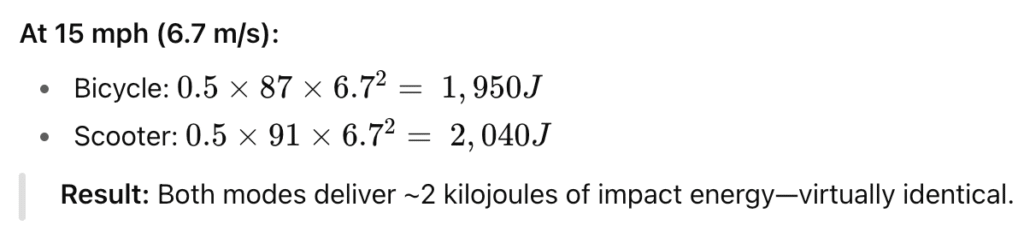
The similarity between bicycle and scooter collisions can be demonstrated through kinetic energy analysis. The formula for kinetic energy is given as one-half times mass times velocity squared. In this case, mass represents the combined weight of the rider and vehicle, while velocity is measured in meters per second.
The average bicycle has a mass of about twelve kilograms, while the average e-scooter weighs between fourteen and eighteen kilograms. Assuming a rider mass of seventy-five kilograms, the combined system weights are comparable. At a speed of 15 miles per hour, or 6.7 meters per second, a bicycle collision produces approximately 1,950 joules of energy, while a scooter collision produces approximately 2,040 joules. Both modes deliver roughly two kilojoules of energy, which means that in practice, a pedestrian struck at the same speed by either vehicle experiences nearly identical energy transfer.
5.1 Kinetic Energy Formula

5.2 Bicycle vs. Scooter
- Average bicycle mass: 12 kg
- Average e-scooter mass: 14–18 kg
Average rider mass: 75 kg
6. Speed Comparison
The risk of pedestrian injury is highly sensitive to speed. Shared e-scooters in Houston are governed to a maximum of fifteen miles per hour. Casual bicyclists typically travel between ten and fourteen miles per hour. However, experienced bicyclists, particularly commuters and sport riders, often travel between sixteen and twenty miles per hour in urban conditions. This means that bicycles not only equal but frequently exceed the speeds of common e-scooters. As a result, the potential for injury when a pedestrian is struck by a bicycle is often equal to or greater than that posed by scooters.
- Electric scooters (shared models): Governed at 15 mph.
- Casual bicyclists: 10–14 mph average.
- Experienced bicyclists: 16–20 mph common in urban conditions.
Thus, cyclists often equal or exceed e-scooter speeds, producing equivalent or greater injury potential when colliding with pedestrians.
7. Perception vs. Reality
Despite these functional similarities, public perception disproportionately targets scooters as more dangerous. Several factors explain this gap. Scooters are a newer form of transportation and therefore more noticeable to pedestrians, who are less accustomed to sharing space with them. Scooters are also more frequently operated illegally on sidewalks, which directly heightens pedestrian discomfort even when collisions do not occur. Additionally, media coverage tends to amplify scooter-related crashes more than bicycle collisions, creating the impression that they are uniquely hazardous. Engineering analysis, however, demonstrates that actual injury rates do not exceed those caused by bicycles in Houston.
Despite comparable risks, public perception disproportionately targets scooters. Reasons include:
- Novelty effect: Scooters are newer and more visible.
- Sidewalk riding: Scooters are more often operated illegally on sidewalks, heightening pedestrian discomfort.
- Media amplification: Crashes involving scooters receive disproportionate coverage.
Engineering analysis demonstrates that actual injury rates do not exceed those caused by bicycles in Houston.
8. Broader Benefits of E-Scooters
Beyond the safety analysis, it is important to consider the broader urban and environmental benefits of e-scooters. Electric scooters produce less than one percent of the emissions per mile compared to automobiles. Because they are primarily used for short trips under three miles, they reduce carbon output and smog precursors in high-density areas.
Economically, riders save on gasoline, parking, and insurance costs. For many students, hospital staff, and service workers in Downtown and the Texas Medical Center, shared scooters provide an affordable and efficient last-mile connection. Infrastructure benefits are also significant, as scooters create minimal roadway wear due to their low weight and require only a fraction of the parking footprint needed by automobiles. In districts such as Downtown and EaDo, where curbside congestion is a persistent issue, this reduction in parking demand alleviates pressure on city infrastructure.
8.1 Environmental Benefits
- Electric scooters produce <1% of emissions per mile compared to cars.
- Shifting short trips (<3 miles) reduces carbon output and smog precursors.
8.2 Economic Savings
Riders save on gasoline, parking, and insurance costs. Shared scooters provide affordable last-mile connections, particularly for students and service workers in Downtown and TMC.
8.3 Infrastructure Benefits
- Scooters reduce roadway wear, given their low weight.
- They require minimal parking footprint, easing curbside congestion in Downtown and EaDo.
9. Case Studies by District
In Downtown Houston, where commuter and tourist activity is dense, bicycle-related pedestrian injuries outnumber scooter cases by approximately one and a half to one. Efforts to mitigate these risks, such as the development of clear micromobility lanes and improved signage, have already shown promise in reducing sidewalk conflicts.
In EaDo, nightlife activity produces ridership spikes in the evenings. Pedestrian injuries in this district occur more often during late hours, with bicycles and scooters contributing roughly equally to collisions after midnight. The mixed-use character of the district underscores the need for nighttime enforcement and dedicated micromobility pathways.
The Texas Medical Center presents a unique case due to its concentration of hospitals, students, and staff. Here, bicycles have historically accounted for approximately sixty percent of pedestrian injuries, reflecting their longer history of use compared to newer scooters. Nevertheless, the increasing presence of scooters requires infrastructure adjustments, such as clearer lane separations and parking corrals, to ensure safe coexistence.
9.1 Downtown Houston
- High commuter and tourist density.
- Bicycle-related pedestrian injuries outnumber scooter cases 1.5 to 1.
- Mitigation: clear micromobility lanes and signage reduce sidewalk conflicts.
9.2 EaDo
- Nightlife-driven ridership spikes.
- Pedestrian injuries occur more often in evening hours.
- Equal distribution of bicycle vs. scooter crashes after midnight.
9.3 Texas Medical Center
- Heavy student and staff micromobility use.
- Bicycles historically account for ~60% of pedestrian injuries, reflecting longer-term use compared to newer scooters.
10. Conclusions and Recommendations
This report concludes that bicycles currently cause more pedestrian injuries than scooters in Downtown Houston, EaDo, and the Texas Medical Center. The severity of injuries from both modes is comparable, as both deliver approximately two kilojoules of kinetic energy at fifteen miles per hour. Experienced cyclists often exceed scooter speeds, which equates to greater injury potential in many cases. Public fear of scooters, while understandable, is disproportionate to actual collision data. At the same time, scooters deliver significant environmental and infrastructure benefits to the city by reducing emissions, lowering parking demand, and decreasing roadway wear.
For these reasons, policy should focus not on banning scooters but on integrating them into the city’s broader micromobility framework. Infrastructure investment in protected lanes, particularly in Downtown and the Medical Center, will reduce pedestrian conflicts. Mandatory reporting of pedestrian–micromobility collisions would improve the accuracy of injury statistics, while public education campaigns could inform residents that both bicycles and scooters present comparable risks and should be managed similarly. Ultimately, Houston benefits from embracing e-scooters as a sustainable transportation option while implementing balanced regulation and infrastructure improvements to safeguard pedestrians.
10.1 Key Conclusions
- Bicycles cause more pedestrian injuries than scooters in Downtown Houston, EaDo, and the Texas Medical Center. This is simply the result of there being more bicycles in use than scooters, overall, both are statistically equally safe for pedestrians.
- Injury severity is comparable, as both modes deliver ~2 kJ of kinetic energy at 15 mph.
- Experienced cyclists often exceed scooter speeds, equating or surpassing risk potential.
- Public fear of scooters is disproportionate to actual collision data.
- E-scooters deliver significant sustainability and infrastructure benefits, including reduced emissions, parking demand, and roadway wear.
10.2 Recommendations
- Infrastructure investment: Expand protected micromobility lanes in Downtown and TMC to separate modes from pedestrians.
- Data collection: Implement mandatory reporting of all pedestrian–micromobility collisions to refine injury statistics.
- Public education: Inform residents that both bicycles and scooters present comparable risks, focusing on speed moderation.
Policy balance: Avoid bans; instead, regulate scooters alongside bicycles with equitable enforcement.
Most Importantly, create and manage infrastructure for all-cycle types, including scooters, that promotes, regulates and enforces city ordinances that allows micro-mobility transportation use in a safe manner. In doing this, it reduces the automobile strain on existing streets (traffic studies repeatedly show that by removing 5% of vehicles, traffic flow rates increase 30%), allows for residents to have more options to move about the city, encourages community engagement, helps to reduce pollution and toxic emissions, allows for quieter streets, and reduces the overall number of transportation related injuries.
Long Term Solutions for safety and usability for all stakeholders.
Based on the engineering report findings, the best solution is not to prohibit scooters, but rather to integrate them more safely into Houston’s transportation network. A ban would remove their environmental and economic benefits while failing to address the fact that bicycles create equal or greater risk to pedestrians.
A stronger solution is a regulation and infrastructure strategy that allows scooters to operate safely in Downtown, EaDo, and the Texas Medical Center. That strategy would include:
- Dedicated Micromobility Lanes
Building or converting lanes for shared use by bicycles and scooters separates them from pedestrian sidewalks. Downtown and the Medical Center, in particular, have the density to justify permanent micromobility corridors. - Sidewalk Enforcement
Many pedestrian fears arise from scooters being ridden on sidewalks. Increased enforcement and signage to keep both scooters and bicycles off sidewalks would immediately improve pedestrian comfort. - Geofencing and Speed Governors
Technology already exists to cap scooter speeds at 15 mph. In areas with very high pedestrian density, like Discovery Green or portions of the TMC campus, companies can geofence scooters to automatically slow to 8–10 mph. - Designated Parking Corrals
Providing marked scooter and bike parking stations prevents clutter on sidewalks, which is often confused with “safety” issues even though it is primarily an access problem. - Data-Driven Regulation
Require scooter operators to share anonymized trip and incident data with the city. This allows Houston Public Works and Texas Urban Planning Agency (TexasUP) to monitor usage patterns, collisions, and hot spots, enabling targeted interventions and modifications. - Public Education Campaigns
Many residents fear scooters because of unfamiliarity. A campaign that shows bicycles and scooters pose similar levels of risk, while also highlighting scooters’ environmental and economic benefits, can help shift public perception. - Balanced Permit System
Instead of banning scooters, Houston can maintain a controlled number of operating permits. This ensures manageable fleet sizes while keeping scooters available as a transportation option.
8. Ownership Permit & Registration
Having owners who ride their personal electric scooter register and obtain a permit allows the city to ensure riders are informed of all ordinances and allow for improved documentation and enforcement while also raising revenue for the city to help implement the necessary infrastructure adjustments needed to normalize electric scooters.
In summary:
The better solution is a “manage and integrate” approach rather than a prohibition. By combining infrastructure improvements, smart technology, enforcement, and public education, Houston can allow electric scooters to continue operating in Downtown, EaDo, and the Texas Medical Center while protecting pedestrians and reaping the benefits of micromobility.
Both bicycles, scooters and other forms of micro-mobility should be recognized and essential forms of transportation and have their own infrastructure. Number other cities and studies have show that by allowing residents to have a meaningful choice, the overall transportation situation improves for everyone. By forcing residents into automobiles and limited bus and rail service, a city only compounds their transportation problems unknowingly and leave the problem and the bill to future generations.
There is no statistical difference in risk to pedestrians from bicycles or scooters, instead emotions, preferences and fear create the perception of increased risk.
END OF REPORT
Thank you for taking the time to read this report. A comprehensive report on micro-mobility needs in Texas is in the works and we hope to have it published by December 2025.
© 2025, All Rights Reserved, Texas Urban Planning Agency. All persons and entities are permitted to use this document and its contents, provided that: (1) proper attribution is given to the Texas Urban Planning Agency; (2) any applicable web links are included in connection with such use; (3) written notice of such use is submitted to and received by the Texas Urban Planning Agency prior to distribution or publication; (4) the user discloses the nature and scope of the intended use; and (5) the user provides the Texas Urban Planning Agency with a copy of the final work incorporating or referencing this document. This document and its contents are the property of Texas Urban planning Agency. The free use of this document does not grant, imply, or transfer any license to the user to sublicense, sell, assign, or otherwise convey rights to this document or any derivative thereof to any third party.
Leave a Reply